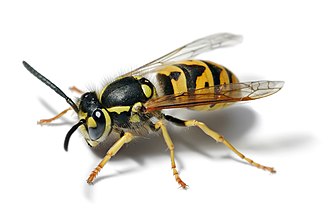
Oriental hornet
Vespa orientalis
Insects · family Vespidae · order Hymenoptera
About
The Oriental hornet is a social insect species of the family Vespidae. It can be found in Southwest Asia, Northeast Africa, the island of Madagascar, the Middle East, Central Asia, and parts of Southern Europe. Oriental hornets have also been found in a few isolated locations such as Mexico and Chile due to human introduction. The Oriental hornet lives in seasonal colonies consisting of caste system dominated by a queen. The hornet builds its nests underground and communicates using sound vibrations. The hornet has a yellow stripe on its cuticle (exoskeleton), which can absorb sunlight to generate a small electrical potential, and this might help supply energy for digging. The adult hornet eats nectar and fruits and scavenges for insects and animal proteins to feed to its young. Because they are scavengers, the hornets may also serve as a transmitter of disease following consumption of infected plants. The hornets are a primary pest to honey bees, attacking bee colonies to obtain honey and animal proteins. The sting of an Oriental hornet can be quite painful to humans and some humans are allergic to stings.
From Wikipedia, CC BY-SA 4.0.
Where it has been recorded




- Records
- 7,698
- Countries
- 54
- Recorded
- 1904–2026
Most records come from
- Greece 2,471
- Spain 1,420
- Italy 962
- Turkey 691
- Israel 264
- Cyprus 214
- Uzbekistan 185
- Iran 178
- Malta 140
- Oman 108
- India 97
- Slovenia 92
Records are places where people found and reported the animal, from GBIF; some come from zoos, museums and tracking studies, and well-studied countries have far more. Squares on the map: brighter means more records.